

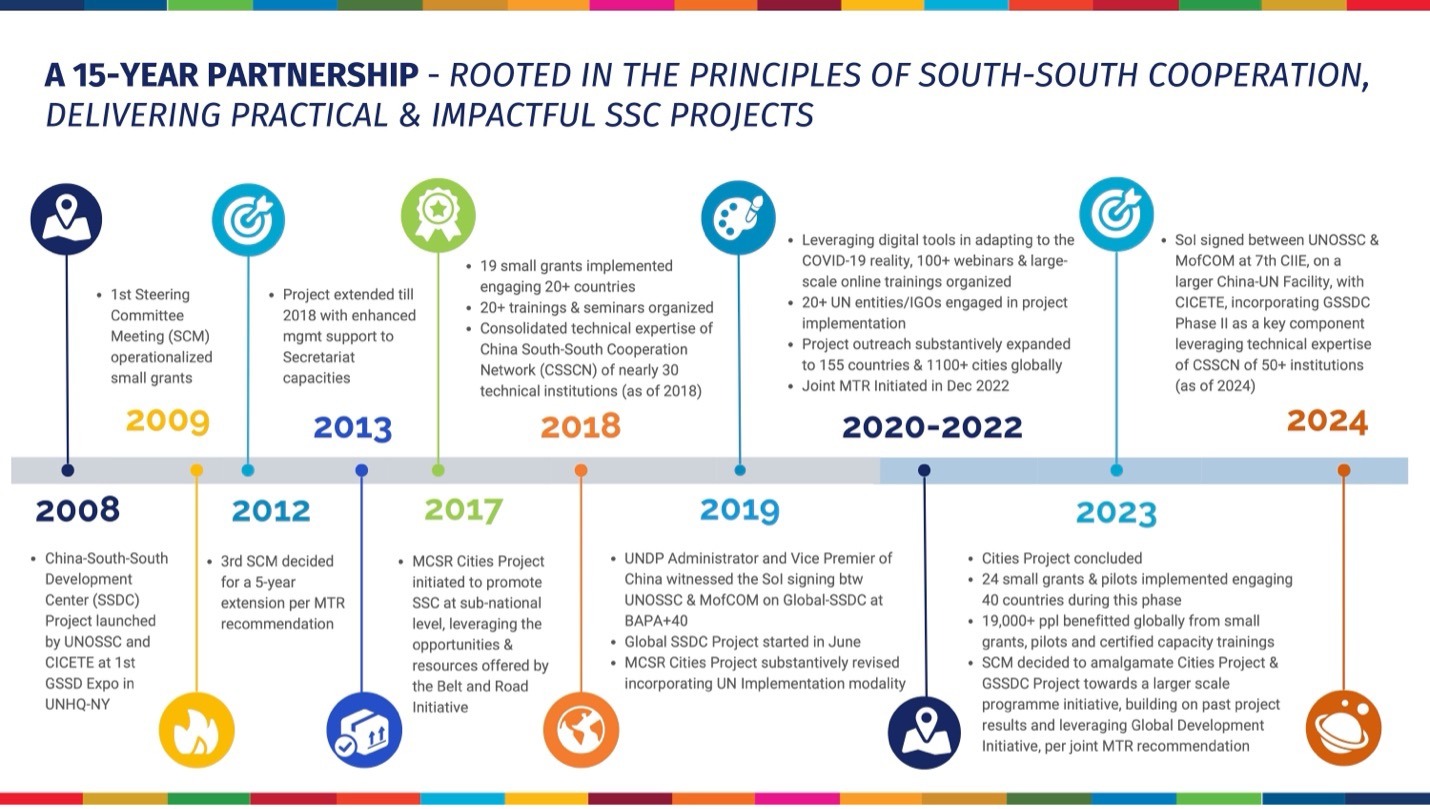
The Global South-South Development Center (GSSDC) is a flagship initiative of the UNOSSC, funded by the Government of China, under the framework of the UN Fund for South-South Cooperation (UNFSSC). It was launched in 2009 in partnership with the China International Center for Economic and Technical Exchanges (CICETE).
GSSDC Phase I was co-initiated in 2019 by UNOSSC and the China International Center for Economic and Technical Exchanges (CICETE), and funded by the Government of China, the GSSDC has delivered capacity-building, policy advocacy, and knowledge exchange for developing countries.
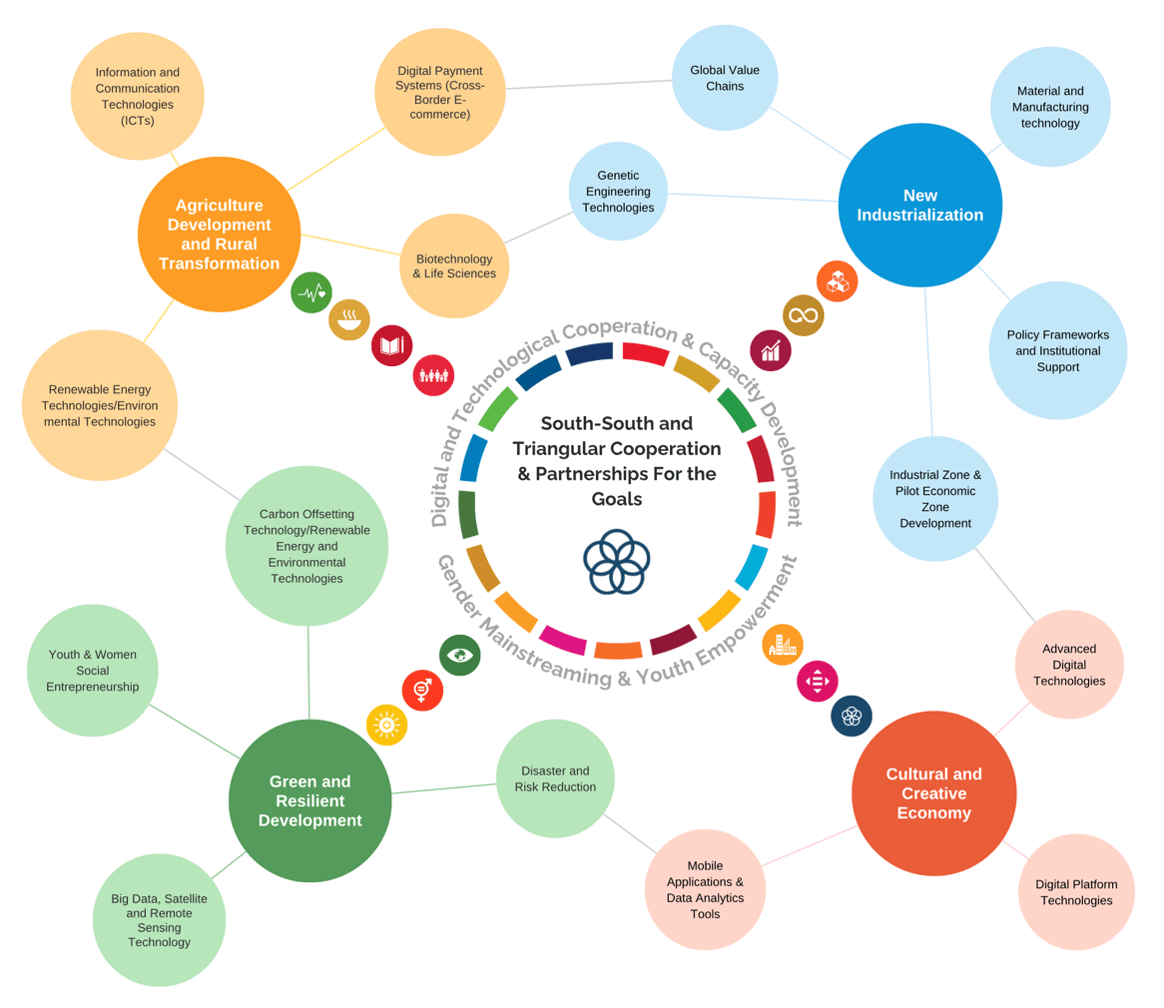
GSSDC Phase II (2024–2030) is now expanding both thematically and geographically, prioritizing: agriculture and rural transformation, green and resilient development, new industrialization, cultural and creative economy. Phase II seeks to leverage the technical expertise and resources of the China South-South Cooperation Network (CSSCN) to advance practical and technological cooperation, capacity development, knowledge exchange and network-building, while promoting South-South and triangular cooperation among cities and sub-national entities globally.
Thematic Focus
- Green and Resilient Development
- Agriculture Development and Rural Transformation
- Cultural and Creative Economy
- New Industrialization
Project Focus
Partnerships
- To enhance the global partnership for sustainable development and leverage partnerships with various stakeholders from multilateral agencies, civil society, private sector, and think tanks, align Global SSDC’s effort with SDGs and other global development frameworks;
Small-Grant Proposals and Capacity Development Trainings
- To support promising small-grant proposals to facilitate technology transferring and capacity building among developing countries.
Project Practice-informed Knowledge Products
- To conduct demand-driven sector-specific research/analysis, document practice-informed knowledge products, and place greater emphasis on two-way knowledge sharing between China and other developing countries.v

Cities Cooperation
- The South-South Cities Clusters unites networks of cities, institutions, and experts to drive horizontal cooperation and exchange. It empowers local governments and development stakeholders to actively participate in thematic South-South and triangular cooperation through capacity building and knowledge sharing, delivering tangible mutual benefits. Key focus areas include e-commerce, digital innovation, sustainable tourism, youth entrepreneurship, disaster risk reduction, public health, climate change, sustainable agricultural value chains, gender equality, and public service improvement.
South-South Cities Clusters





Highlights & Achievements
Small-Grant Proposals Advanced with Impactful Results
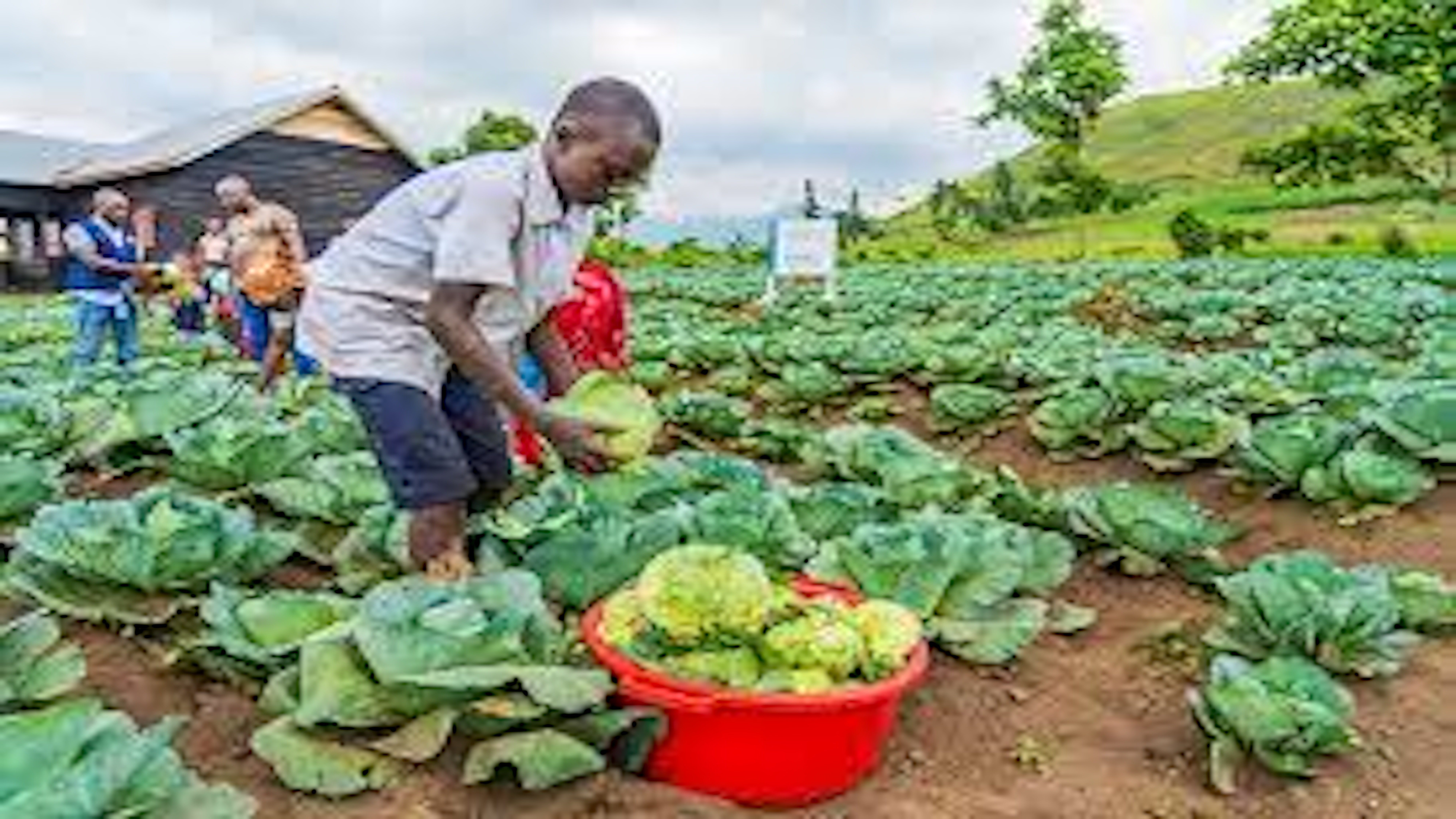
By December 2024, there were 29 small-grant proposals supported by the Project, across various thematic areas including agriculture, forestry, renewable energy, environmental protection, industrial development, etc. These projects have benefitted 50 developing countries.
The funding resources channeled in through public-private partnerships (PPP) by implementing partners, utilized for project implementation in parallel to those granted by SSDC, reached 1.6 times of the core funds needed for implementing these projects. Partners and participating institutions from developing countries, including China, were provided accesses to technologies, equipment and facilities, and opportunities to gain knowledge and develop capacity at the same time. It’s a real “win-win” scenario.
Some of the small grant proposals have been featured on several of UNOSSC flagship publications:
Practice-informed Knowledge products
Throughout the implementation of the SSDC Project, many good practices have been documented and many international policy dialogues were organized. Multiple analytical reports, quarterly South-South Cooperation Updates and timely news briefs were published and disseminated within and beyond its networks. These include:
- COVID-19 has been sweeping across the globe since the start of 2020. To increase understanding of China’s key measures for prevention and control of the COVID-19 in a comprehensive and objective manner, Center for International Knowledge on Development, with the support of Global SSDC, compiles Fighting the COVID-19: 100 Q&As, which focuses on widely-discussed questions and aims to facilitate understanding of similarities and differences from a comparative perspective;
- China SSDC Project, in partnership with Nankai University, jointly developed the China Development Report on South-South Cooperation, a report series outlining trade, investment and development relations between China and other developing countries;
- In 2014, China SSDC and UNDP Country Office in China jointly developed the UNDP in China—History and Opportunities, a publication that shared successful experiences, proposed new perspectives and approaches and further advocates China’s South-South cooperation strategies.

Factsheet: SSC &TrC in Sustainable Agriculture & Value Chain Development in Côte d’Ivoire

Improving Business Environment in China: Practices and Experiences

Research on Participation of Private Businesses in the Development of the Belt and Road and Investment in Africa

South-South in Action: China South-South Development Center

Promoting Biogas Development through South-South Cooperation and Communication

GSSDC 2020 Highlights


Partner Institutions

Related

“一带一路”国家气候变化与极端灾害事件管理研讨会 成功召开
[vc_column column_padding="no-extra-padding"...
Five-day Training Workshop on Climate Change and Extreme Disasters Management along the Belt and Road Successfully Concluded
[vc_column column_padding="no-extra-padding"...
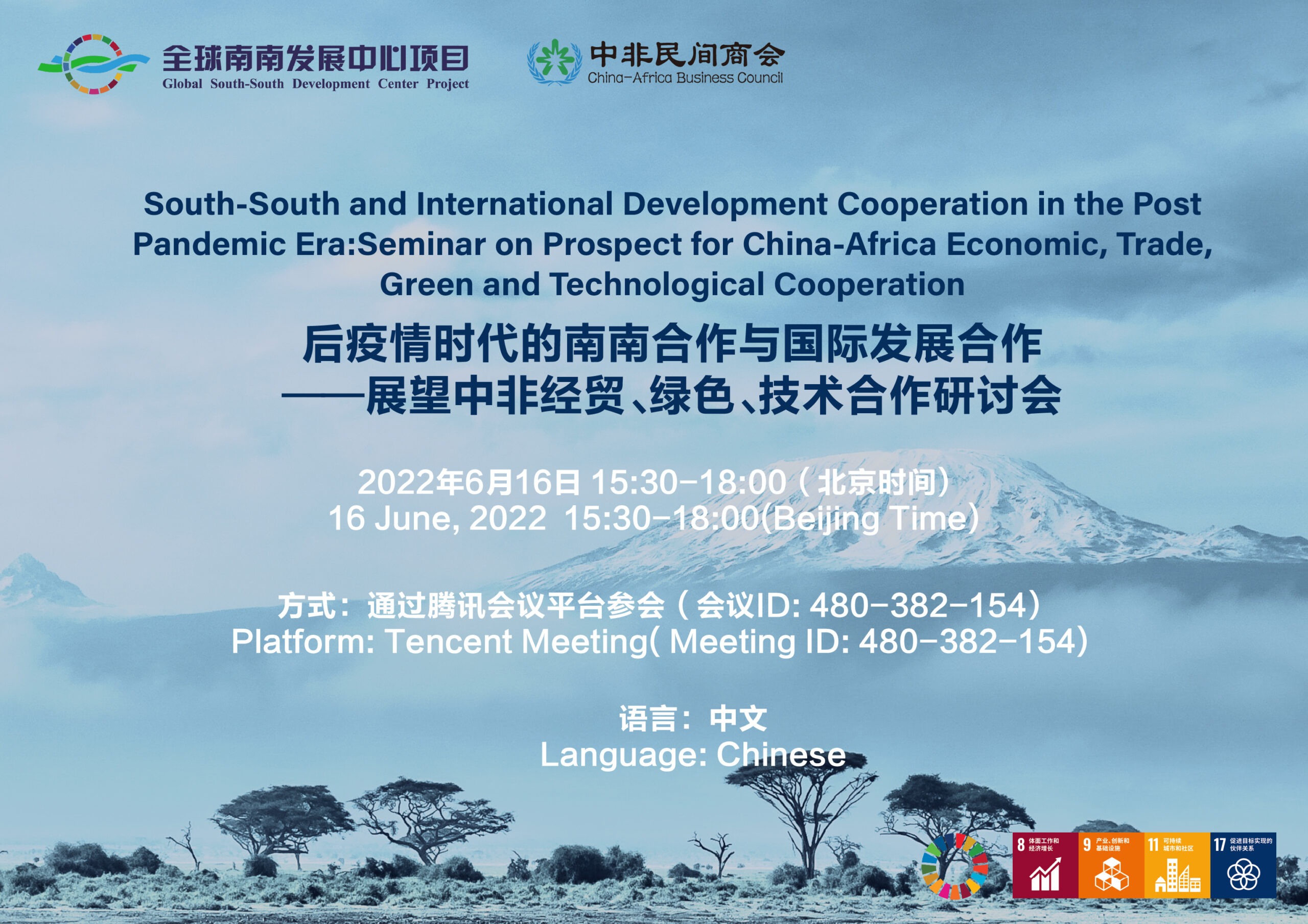
Seminar on the Prospects for China-Africa Economic, Trade, Green & Technological Cooperation, 16 June 2022
South-South and International Development Cooperation in the Post Pandemic Era: Seminar on the Prospects for China-Africa Economic, Trade, Green and Technological Cooperation When: Thursday, 16 June 2022, 3:30 – 6:00 PM (Beijing Time) Meeting Language: Chinese How to...
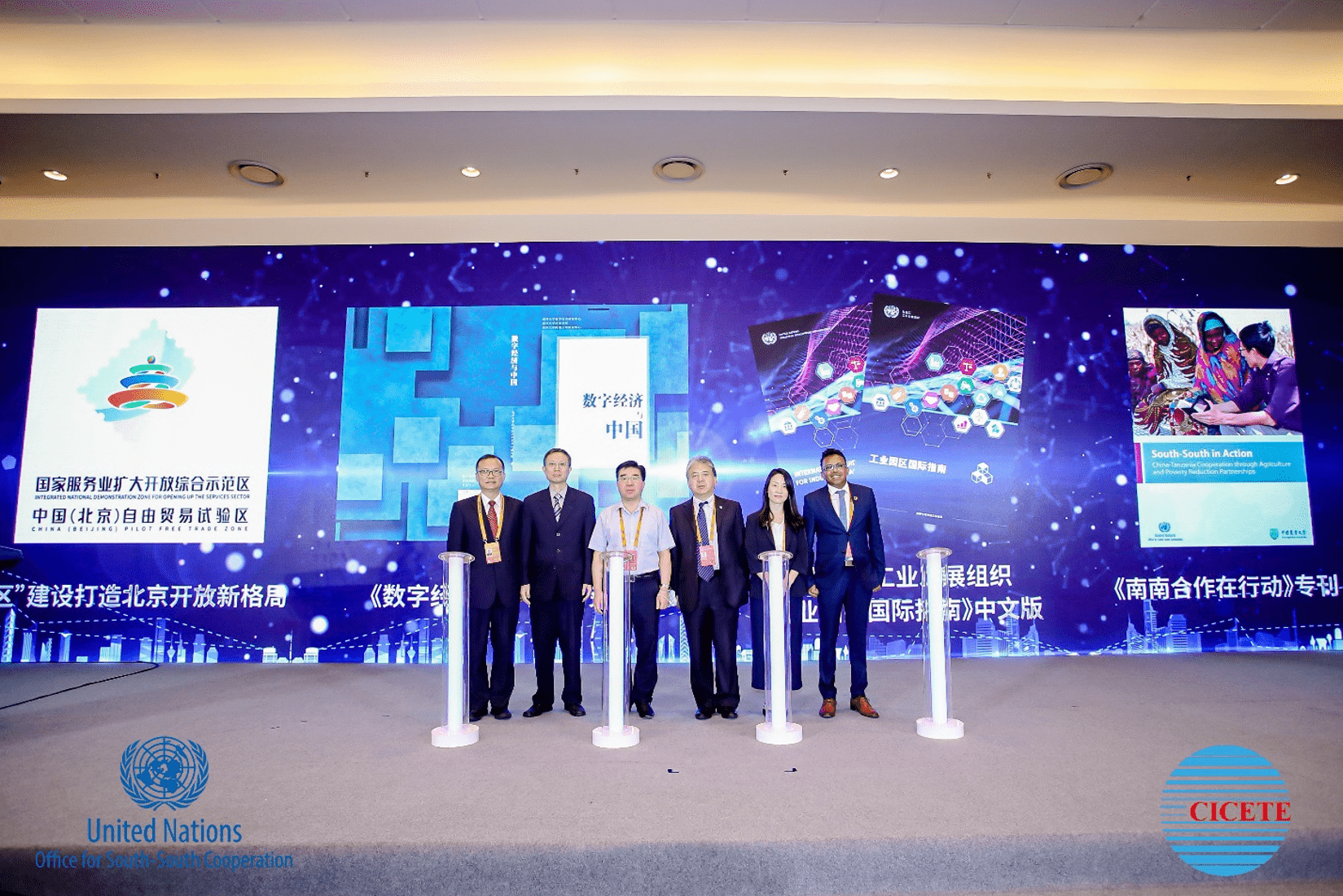
South-South Cooperation Crucial to Close Digital Divide and Build Inclusive and Resilient Economies
[vc_column column_padding="no-extra-padding"...