
4–5 December 2025 | Seoul, Republic of Korea — National and local government officials, regional institutions, development partners, academia, and private-sector innovators gathered in Seoul for the Final Regional Stakeholder Forum of the ROK–UNOSSC Facility (Phase 3)/P-LINK, held under the theme “WEF-X Nexus, Innovation and Partnerships: From Pilots to Pathways in the Mekong–ROK, and Beyond.”
The two-day event celebrated five years of collaborative innovation and charted a forward-looking agenda to scale WEF-X Nexus solutions across the Mekong region.
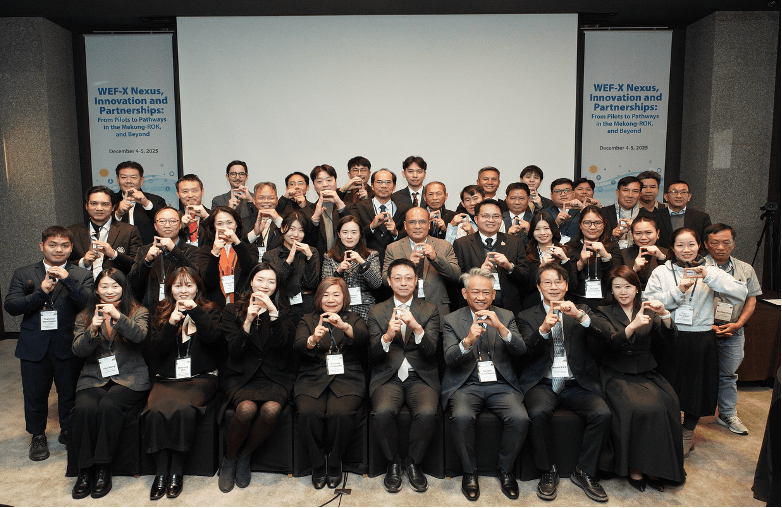
In his opening address, Mr. Sunghoon Hwang, Director-General of Ministry of Science and ICT (MSIT), reaffirmed Korea’s long standing commitment to STI driven development cooperation:
P-LINK has demonstrated how science and technology can translate into meaningful improvements at the community level. From expanding access to clean water to deploying smarter early-warning systems, the pilots show tangible results that directly enhance people’s daily lives.

This sentiment was echoed by all partners throughout the Forum, underscoring how ROK’s STI leadership, combined with country-driven priorities, forms the backbone of P-LINK’s triangular cooperation model.

Dr. Ji Woong Yoon, President of the Science and Technology Policy Institute (STEPI), highlighted the essential role of science and evidence in shaping durable development pathways:
Innovation delivers impact only when paired with strong policy pathways. Korea remains committed to working with Mekong partners to ensure that STI-driven solutions are not only piloted, but also institutionalized and scaled. P-LINK reflects our shared commitment to turning research into action and action into long-term development outcomes.
From the Mekong River Commission, Ms. Busadee Santipitaks, CEO, emphasized how pilots inform regional cooperation
These are not just technical milestones—they reflect national leadership and community-centered innovation now informing our Strategic Plan 2026–2030. As we move from pilots to pathways, national and local ownership must remain at the center.
Mekong Institute Executive Director Mr. Suriyan Vichitlekarn emphasized capacity development as a driver of long-term Nexus leadership:
Capacity development was not a stand-alone activity—it was embedded throughout the project. The Nexus approach is now a key thematic area in MI’s Strategic Plan 2026–2030, and we look forward to continued partnership through the 2026 Mekong Forum on ‘Nexus and Partnership for a Robust GMS.
UNOSSC Director Ms. Dima Al-Khatib highlighted triangular cooperation as a defining strength of P-LINK:
The learning journey we undertook together—peer-to-peer exchange, joint problem-solving, and adaptation—is at the heart of what this Facility set out to achieve. These lessons will guide P-LINK’s evolution into a flagship regional platform for innovation and cooperation.v
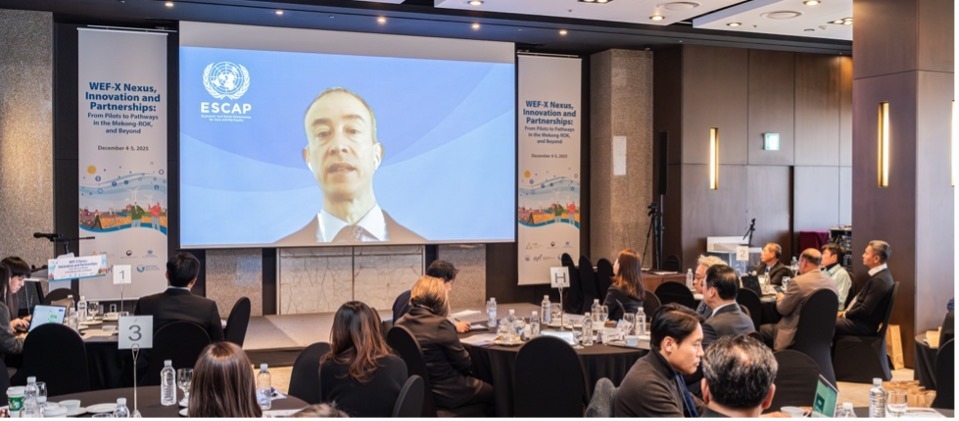
Delivering the keynote, Mr. Lorenzo Santucci, Chief of Environment and Development Policy Section at the United Nations Economic and Social Commission for Asia and the Pacific (ESCAP), emphasized the importance of Nexus-informed policymaking in a rapidly changing region:
The WEF Nexus is not just a technical concept—it is a policy lens that transforms trade-offs into synergies. Stronger governance, scaled innovations, and investment in data and digital tools are essential for climate-resilient development. ESCAP looks forward to exploring opportunities to work more closely with P-LINK to accelerate integrated, region-wide solutions.
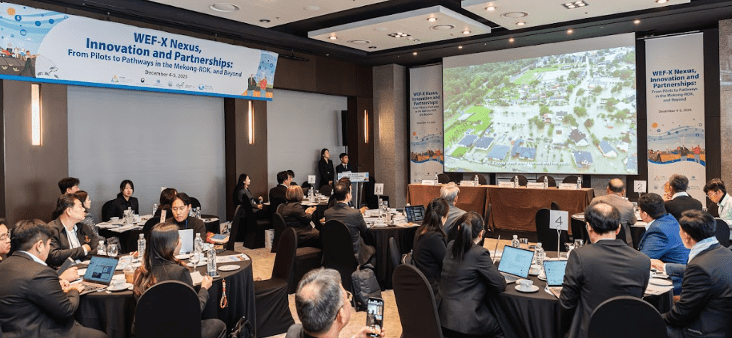
The Forum’s policy dialogue reflected shared recognition that transitioning from pilots to system-level change requires close alignment between science, policy, and practice. Ms. Eunyoung Huh, Director at MSIT, reaffirmed Korea’s readiness to support this transition:
As we look to the next phase, MSIT is committed to supporting models that strengthen institutional ownership, mobilize new partnerships, and embed Nexus approaches into national and regional development agendas.v

Dr. Hwanil Park, Senior Research Fellow at STEPI, highlighted the dual role of innovation and policy in enabling scale:
There is no single process for moving Nexus solutions into policy. Evidence from pilots, practical demonstrations, and market demand must inform policymakers as they create the enabling environment for adoption. Policy and innovative practice must move hand-in-hand—bottom-up insights and top-down guidance reinforce each other.
Across the discussions, Mekong government representatives emphasized the importance of engaging youth volunteers as future trainers, strengthening community-level ownership, and collaborating with academic institutions for research, data analysis, and practical application. These elements were recognized as essential to ensuring sustainability and replication of Nexus solutions across the region.
A shared vision emerged as the Forum concluded: P-LINK’s value lies not only in its tangible pilot results but also in the ecosystem of cooperation it has built—connecting science, policy, innovation, and communities across the Mekong and the Republic of Korea. Stakeholders expressed strong interest in deepening this collaboration through a next phase focused on the WEF-Urban X Nexus, digital innovation, regional knowledge platforms, and scalable, evidence-based solutions that can support long-term resilience and sustainable development.