
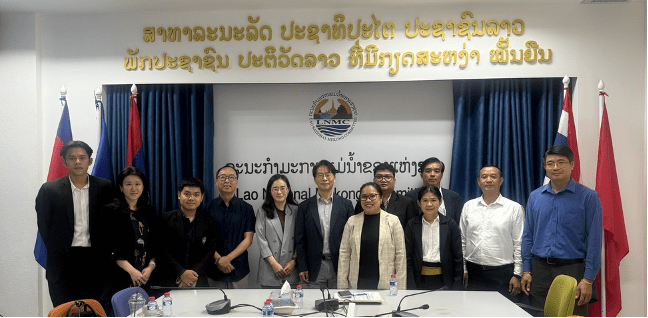
Vientiane, 25 November 2025 — Lao PDR convened a high-level national dialogue today to advance the country’s long-term vision for integrated water governance. Senior officials from the Department of Meteorology and Hydrology (DMH), the Department of Water Resources (DWR), development partners, and technical experts came together to review the proposed Improvement Plan for the National Water Resources Data Management Center (NWRDMC).
The dialogue was organized under the P-LINK project (RoK–UNOSSC Facility Phase 3), implemented by the United Nations Office for South-South Cooperation (UNOSSC) and funded by the Ministry of Science and ICT of the Republic of Korea.
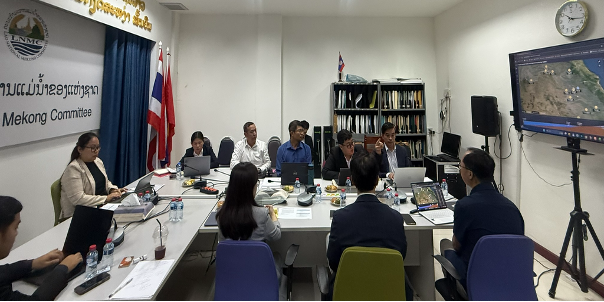
Chaired by Mrs. Soudavee Keopaseuth, Deputy Secretary General of the Lao National Mekong Committee (LNMC), the meeting highlighted Lao PDR’s commitment to modernizing its water-information systems and strengthening national capacity for flood and drought forecasting, data integration, and climate-resilient planning through the application of science and technology.
A Roadmap for Modern Water Data Management
Korean technical expert Mr. Eugene (Yoojin) Kim, Director of Hermesys, presented the proposed NWRDMC Improvement Plan, which outlines how the Center can evolve into the national hub for real-time water-resource monitoring and risk management.
The plan focuses on three core priorities:
- Integrating hydrological, meteorological, and hydropower data into a single, interoperable platform;
- Introducing AI-enabled forecasting tools and real-time modelling for improved early warning; and
- Strengthening cross-agency coordination through standardized data-sharing protocols.
Participants emphasized that reliable, timely water information is increasingly vital as climate change intensifies extreme weather and hydrological uncertainty. Stronger data systems, they noted, will directly benefit irrigation planning, hydropower management, disaster preparedness, and regional cooperation.
P-LINK Lao Pilot as a National–Local Model
The meeting also recognized the P-LINK Lao pilot as a model linking national policy reform with local resilience. The pilot’s AI-based Flood Forecast Early Warning and Monitoring System was officially launched during the dialogue and the hydro-meteorological monitoring stations scheduled on November 27
This two-tiered approach—combining national water-data reforms with practical community-level tools—was praised as a proof of concept for how innovation, policy, and local ownership can reinforce one another.
Ms. Yejin Kim, P-LINK Project Manager, UNOSSC, encouraged stronger national stewardship as the project approaches completion:
The systems established under P-LINK will only be sustained through continued national and provincial leadership. We hope partners will build on this momentum and explore synergies for future scaling.
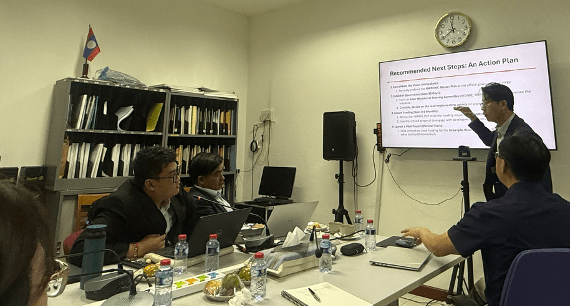
Dr. Hwanil Park, Senior Research Fellow, Science and Technology Policy Institute (STEPI) underscored the importance of linking practice to policy:
It is essential to document how the advisory support and the integrated water–energy–food nexus solutions applied through P-LINK have strengthened both national coordination and community resilience. These lessons can guide future decision-making and institutionalization.
Next Steps
The dialogue concluded with the agreement to finalize the improvement plan of NWRDMC and its project concept paper and formally endorse it as an official government blueprint. To ensure sustainability and scalability, it is required to secure dedicated government budget for Operations & Maintenance (O&M) and Explore cost-sharing with private sector partners and international organizations. Furthermore, additional support will be arranged for refining
technical requirements, support capacity building, ensure Lao-language accessibility, and explore expansion to additional provinces and river basins.
Lao PDR’s collaboration with regional partners and the Republic of Korea reflects a growing commitment to science, technology, and innovation for climate resilience. The national dialogue marks an important milestone toward building a more integrated, data-driven, and water-secure future for the country.